If you’ve ever watched your Dachshund pretend not to hear you, bark at a leaf for five straight minutes, or out-smart your baby gates like a tiny Houdini, you already know: a Doxie’s brain is powerful. Powerful brains need direction.
Without it, that energy turns into stubbornness, barking, digging, guarding, and selective hearing at the worst possible times. 🐾
“Brain training” is built for this exact breed profile. Instead of pushing more corrections or louder commands, it channels curiosity and problem-solving into short, rewarding games that build focus and self-control.
When a Dachshund practices pausing before reacting, you get quieter evenings, calmer walks, and a dog who wants to cooperate because it pays off. ✨
This review looks at Brain Training for Dachshunds — what’s inside, why the method clicks with Doxies, where owners get stuck, and how to set yourself up for real results without expecting overnight miracles. 💡
Key Takeaways ✨
- Mental work reduces barking, digging, and stubbornness by giving the brain a job. 🧠
- Short, reward-based games build self-control and better listening without harsh methods. ✅
- Tiny daily sessions (10–15 minutes) work better than rare long training days. ⏱️
- Progress comes in layers — attention first, then obedience, then calmer habits. 📈
- Works best for patient owners willing to celebrate small, repeated wins. 💛
🐾 Free Dachshund Care Guide
Download our free checklist to ensure your Dachshund stays happy, healthy, and well-loved!
Get Your Free Guide 🐶Why Mental Training Matters for Dachshunds
Dachshunds were bred to make independent decisions underground. That history shows up today as quick reactions, scent-obsession, and a fierce little streak of “I’ve got this.” It’s wonderful — and maddening — depending on the situation. 🐾
Left to their own devices, most Doxies create their own jobs: patrolling windows, “excavating” the sofa, or announcing every hallway footstep like building security. Physical exercise helps, but it doesn’t drain the mental charge that fuels those habits.
Mental training does. When a Doxie plays pattern-based games — wait → watch → try → earn — their brain gets the same “feel good” payoff they chase through mischief. 🎯
Over time, that payoff transfers to you:
- Your voice predicts the next puzzle.
- Your cues unlock rewards.
- Your presence becomes the guide — not the obstacle. ✨
That’s the bridge between independence and cooperation.
What Is Brain Training for Dachshunds?
Brain Training for Dogs is a structured, self-paced online program created by a certified trainer, Adrienne Farricelli. It breaks training into small, progressive lessons that use positive reinforcement — treats, toys, and praise — to build focus, calmness, and better behavior. 🧠
What you get inside
- Step-by-step written lessons and short video demos 🎥
- Game-style exercises for attention, impulse control, and recall 🎯
- Printable cheat sheets for quick reference and consistency 🗂️
- Level-based progression — starting with simple wins and building up gradually 📈
It’s not a “watch once and your dog magically changes” kind of product.
It’s a repeatable blueprint you can actually follow because the sessions are tiny, achievable, and designed to feel like play — not pressure. ✅
Inside the Program — What Doxie Owners Actually Do
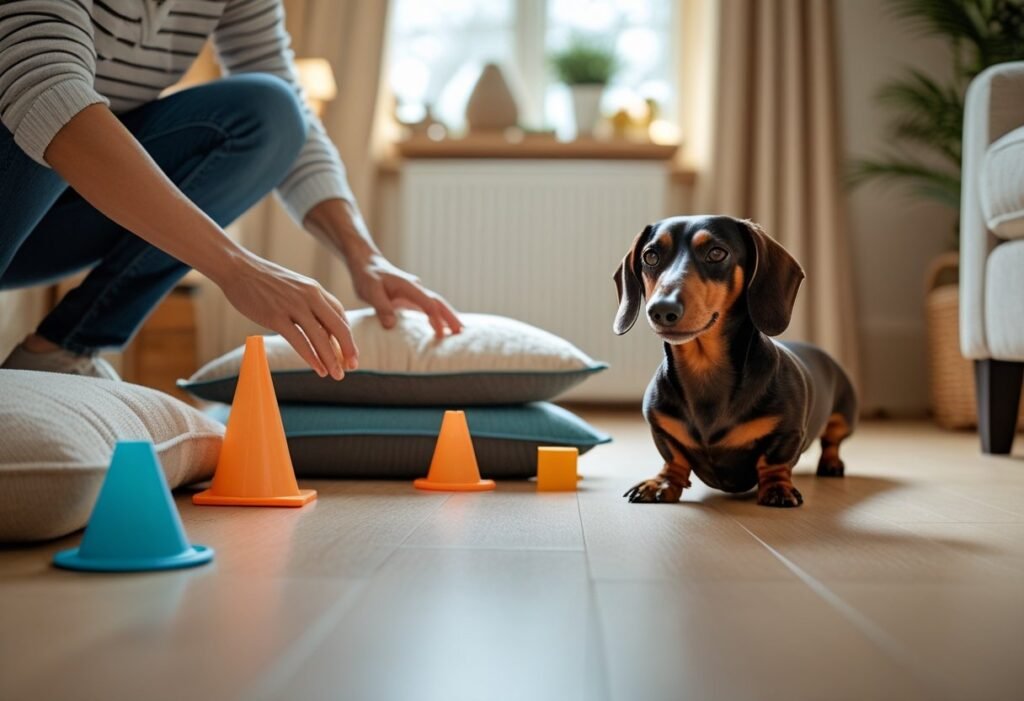
Each lesson takes just 2–5 minutes and is repeated in different rooms before you ever try it outdoors. The curriculum is built on three pillars that work especially well for Dachshunds:
1) Focus and Engagement
Exercises that teach your Doxie to check in with you first — name response, eye contact, handler orientation, and fast “check-ins.”
For scent-driven dogs, these micro-skills are gold. You can’t cue obedience if you don’t have attention. 👀
2) Impulse Control
“Pause first, act later” games: wait for the bowl, pause at a doorway, hold a sit while a lure moves.
Start with a three-second pause, then later add the door crack or movement. These aren’t flashy tricks, but they are the engine behind quieter barking, gentler greetings, and fewer door dashes. ⛔➡️✅
3) Problem-Solving Games
Nose-based puzzles, shaping simple behaviors, “find it” searches, hiding treats under cups or cloths.
Mental work tires a Dachshund faster than another lap — and it’s kinder on long backs. 🧩
You won’t find punishment, force, or exhausting heel drills in this program. Everything is brief, upbeat, and designed to build a streak of small wins that add up. ✨
A few minutes a day can replace chaos with calm and cooperation in a way harsh training never could. 🧠 See how the program works →
How Brain Training Works (and Why It Fits Dachshunds)

Dachshunds don’t obey — they negotiate.
If the reward is fair, the ask is clear, and the step is achievable, they’ll engage. Brain training uses that psychology by stacking tiny, repeated wins.
What makes it work
Cue clarity
One cue → one behavior → one reward.
No long speeches. Clear rules soothe a clever dog who would otherwise write their own. 🎯
Shaping in tiny slices
You reward progress, not perfection.
This keeps stubborn minds invested — “I still get paid for trying.” 💡
Short, rhythmic sessions
Two to four micro-sessions beat one long marathon.
Doxies love fast victories — and you avoid the “I’m done” shutdown. ⏱️
Choice and control
Many games let the dog choose (touch target, offer eye contact, leave it).
When a Dachshund feels they are choosing instead of being forced, buy-in skyrockets. 🚀
“We stopped wrestling for attention and started paying for it. Ten seconds of eye contact gets a treat, and suddenly he offers it all day.”
— Nina R., NJ ✨
What You’ll Need (and What You Can Skip)
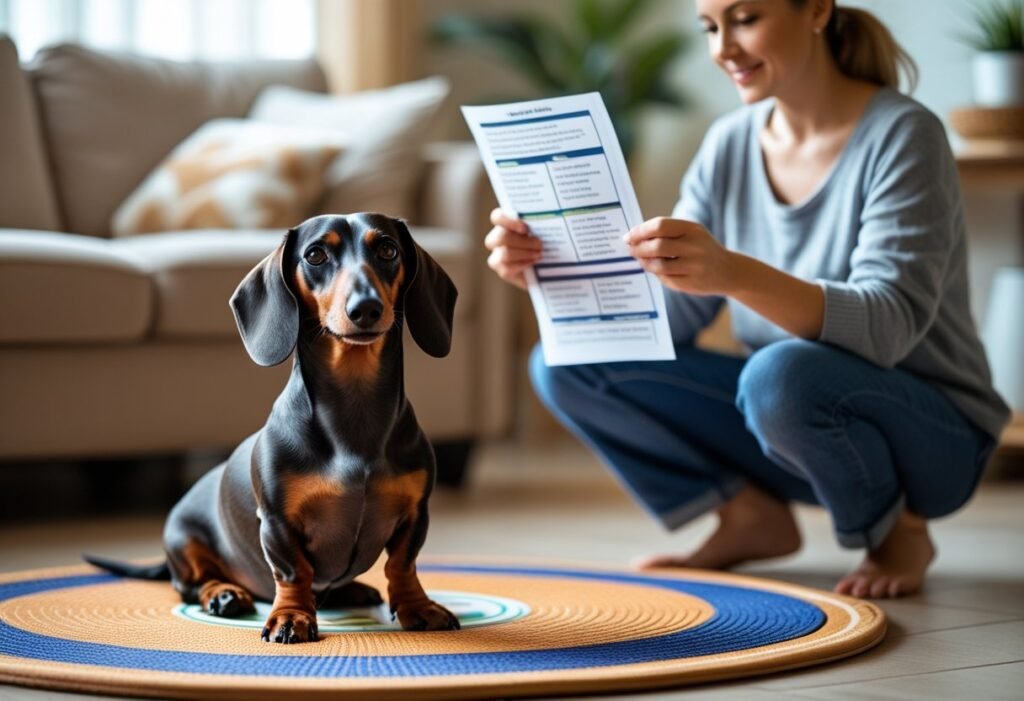
You don’t need a garage full of training gear. Most Dachshund families succeed with just:
- Soft, pea-sized treats (high value for harder tasks, regular for easy wins) 🍖
- A clicker (optional) or a crisp verbal marker like “Yes!” 🎯
- A 6–10 ft leash and flat collar/harness for safe guided sessions 🦮
- Household items — cups, boxes, towels, a small mat for “place” work 🏠
And equally important — what not to use:
Avoid high jumping, repeated stair drills, or rough tug if your Doxie has back risks.
Brain training is low-impact by design — keep it that way. 🧘♂️
Who It’s For — and When to Get Extra Help

Not every Dachshund or household is the same — this kind of training works best in certain situations and needs backup support in others.
Best fit for:
- First-time owners who can do 5–10 minutes a day 🕒
- Barking or window-patrol Doxies who need a mental job indoors 🏠
- Apartment homes or bad-weather families with limited space 🌧️
- Senior or IVDD-history Dachshunds needing low-impact enrichment 🧘♀️
These are the homes where brain training tends to deliver the fastest, clearest wins.
Consider professional help if:
- There is a bite history toward humans — this requires assessment
- Severe separation distress (howling, self-injury, nonstop panic) is present — this calls for a vet/behaviorist plan
- You cannot maintain even 3–4 micro-sessions per week — a positive-reinforcement trainer can help build structure fast
Getting help early is not a failure — it simply protects your dog’s safety and speeds up progress when the baseline is too hard to handle alone.
14-Day Starter Plan for Dachshunds
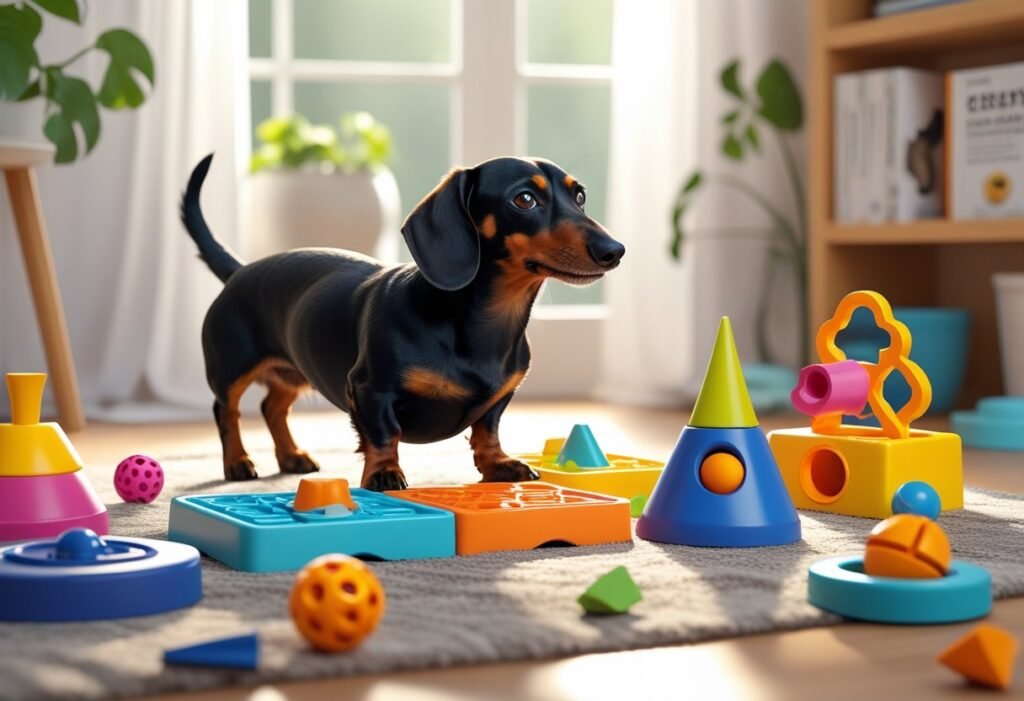
Think 10 minutes total per day, split into tiny bursts. You’re building a habit first — results second. 🧠⏱️
Days 1–3 — Foundation behaviors
- Name + eye contact: Say name once → mark glance → reward 👀
- Hand target: Present palm → nose boop → reward (great redirect tool) ✋
- Mat settle: Toss treat to mat → pay stepping on → later pay for lying down 🧘♀️
Days 4–5 — Control and calm under triggers
- Leave it: Closed fist; pay when nose backs off 🚫
- Sound neutrality: Faint knock/chime → cue mat → quiet earns pay 🔔
Days 6–7 — Recall + nose work
- Indoor recall: One call → reward at feet → end while they still want more 📣
- Scent puzzle: Hide treats under cups → finish with calm mat reset 🧩
“We do three mini sessions a day. The hallway barking dropped because he finally has a job.”
— Gabe S., ON 🐾
Week 2 — Light Distraction Layer (Still Under 90 Seconds)
Once week 1 is smooth, add tiny real-life distractions without increasing difficulty.
- Eye contact with mild distraction (TV, someone walking) — pay fast at knee
- Hand target into heel zone — 2 small steps → mark → release
- Mat settle with distance — 3-second hold while you take 1 step
- Leave-it with dropped food — pay for looking away, not resisting forever
- Doorway recall (3 m) — one call → big reward → end early
- Door knock → mat — pay 3–5 seconds of quiet
- New-room scent puzzle — finish with 2 calm breaths on mat
After two weeks your Dachshund is not “trained” — but they are now thinking before reacting, and that shift is the foundation everything else sits on. ✅
If two weeks of tiny sessions can shift how your Doxie thinks before reacting, imagine the change at 4–6 weeks. 📅 Begin the training plan →
Real Dachshund Owner Results

Real Dachshund families have seen noticeable changes once they added brain training into daily life:
“Pepper used to wind herself up by 6 pm — zoomies, barking at every hallway sound. Week three, she chose the mat when the neighbors came home. That felt huge.”
— Harshita K., CA 🐾“My rescue Doxie ignored recall outdoors. Switching to hand targets and paying big for check-ins gave us the first reliable ‘come’ we’ve ever had.”
— Mark E., AZ ✅“Ours went from hallway patrol officer to post-dinner napper once we added two scent games a day. It changed the whole vibe of the evenings.”
— Rhea M., WA 🌙“Using brain games inside the crate stopped the whining. After two weeks, he started going in on his own because he expected a ‘job’ to do.”
— Daniel S., NY 📦
These are not miracles — they’re consistent small wins stacking over time.
Pros & Cons for Dachshund Homes
Like any training method, brain training has strengths and trade-offs. Here’s what matters most for Doxie parents:
Pros ✅
- Breed-friendly structure — short, rewarding steps suit stubborn minds 🧠
- Low-impact — mental work tires without stressing long backs 🛋️
- Transferable skills — eye contact, hand target, mat settle solve daily problems indirectly 🔄
- Relationship-first — your Doxie learns that paying attention to you predicts fun outcomes 🤝
- Home-friendly — easy to weave into busy days and small spaces 🏠
Cons ⚠️
- Requires consistency — 5 minutes daily beats “weekend warrior” sessions ⏱️
- Motivation matters — some Doxies need higher-value rewards than expected 🍗
- Not an overnight fix — long-built barking habits unwind in layers 📉
- Owner learning curve — timing and criteria feel weird for the first week or two 🎯
Bottom line: it works very well for Dachshunds — as long as the human sticks with it.
What Results to Expect (First Changes vs Later Changes)

Brain training does not “flip a switch” — it shifts patterns in stages. This is what most Dachshund parents notice first:
Stage 1 — Attention shifts
By day 4–5, many Doxies start offering eye contact on their own — often right before they would have barked or bolted. 🧠
Stage 2 — Responsiveness improves
Cues land faster, recalls happen more often, and you start seeing the “thinking face” during excitement. ✅
Stage 3 — Habits soften
Evenings get quieter, window patrol fades, mat naps increase, and greetings become calmer.
This is where life gets easier — and it lasts if you keep the micro-sessions alive. 🌿
Track progress in 2 weeks
- Check-ins per day: target 5 → 15+ 👀
- Indoor recall at 5 m: target 60% → 85%+ 📣
- Window barking: 6–8 bursts/night → 1–2 brief alerts 🪟
- Mat settle time: >5 min → <2 min to relax at night 🛏️
If progress stalls, shrink the task and raise the pay. That isn’t “giving in” — it’s teaching your dog how to win again. 💡
Real progress with Dachshunds is layered, not instant — and that is exactly what makes it stick.
When you see the first “pause instead of react” moment, you realize the method is working beneath the surface. 📈 See real results inside →
Brain Training vs Alternatives (When to Pick What)
Brain training is not the only option — but it fills a different role than classes, apps, or random YouTube videos. Here’s how they compare:
In-person classes
Great for social proofing and handler coaching.
Not always tailored to Dachshund backs or attention span.
Works best as a complement if the trainer uses positive reinforcement and understands scent-driven breeds. 🐕
DIY YouTube playlists
Endless ideas, no structured progression.
Easy to chase novelty without building foundations. 🎥
Training apps
Convenient and game-like, but generic.
If you use one, you still need breed-specific adjustments — shorter reps, higher rewards for calm, more scent puzzles. 📱
If you can only choose one, brain training at home is the best daily lever for most Dachshund families.
Classes and apps work best after a foundation exists — not instead of it. ✅
Troubleshooting & Quick Fixes for Dachshunds

Dachshunds will test any training system. When progress stalls, adjust — don’t quit.
Loses interest after 2 minutes
Cut to 30–60 seconds. One rep, jackpot, end. Small deposits beat long sessions. ⏱️
Barks through the whole session
Start with a sniff-and-settle (scatter a few kibbles on a mat).
Then pay for 2 seconds of eye contact — barking and foraging don’t coexist. 🍂
Takes treat and bolts
Feed at your knee to keep the orbit tight.
If energy spikes, drop to easier reps you can reward fast. 🧍♂️
Outside is hopeless
Teach indoors first, then move stepwise:
living room → hallway → front step → driveway — only level up when 4/5 reps are calm. 🚪➡️🌳
More toy-driven than food-driven
Use the toy as payment: one behavior → toss toy → cue mat settle → repeat. 🧸
Training when the dog is already frustrated
Use soft, easy treats and keep reps under five to prevent burnout. 🍗
Jumping to the yard too early
Master it in the hallway before adding outdoor chaos. 🚶♂️
Paying too late
Mark the exact moment the behavior begins — not after digging in the pouch. 🎯
Expecting long calm too soon
Pay for 1–2 seconds first, then build to 3–5 later. 🧘
These fixes don’t “give in” — they make winning possible, so your Doxie stays in the learning frame instead of shutting down.
You don’t need a perfect dog to make progress — you need a plan that adapts when they push back. 🛠️ View the full solution guide →
Back-Friendly Enrichment for Dachshunds

These activities give your Doxie a job without risking their spine. Rotate them through the week instead of using the same one daily:
- Snuffle mat meals — slow, quiet, scent-first work 🧠
- Towel burritos — wrap a few treats in a towel and let the nose unroll 🧻
- Cup shuffles — hide treats under cups, swap positions, release to search 🎯
- Cardboard foraging — tiny holes in a box lid with kibbles inside; light and tearable 📦
- Nose-touch scavenger — sticky note on walls; pay for touches, then play “find the note” 🏷️
- Settle-paired sound — low door knock → cue mat → pay for quiet 🔔
Always end enrichment with a calm finish — two deep breaths on the mat before release.
That excitement → calm arc is where the real behavior change happens. 🧘♀️
Pricing, Access & Guarantees — What to Expect

Brain Training for Dogs is typically sold as a one-time access program with a full curriculum and support materials. Pricing and refund windows vary by promotion, but the value equation is simple:
If you will practice 5–10 minutes a day, even just 2–3 days per week,
the return is high.
If you want a passive, hands-off fix, this is not that — the course is the plan; you are the engine.
What to look for before purchasing
- Clear refund terms — helpful if you’re new to positive reinforcement 💬
- Immediate access to beginner modules so you can start the same day you buy ⚡
- Printable checklists and cheat sheets you can stick on the fridge for consistency 🗂️
The financial cost is small — the real cost is consistency. The owners who commit, even lightly, get the payoff.
What Real-World Success Looks Like for Dachshunds

Successful Dachshund homes don’t run like boot camps — they run on predictability and tiny, repeatable wins. Meals arrive on time. Sessions are short and playful. Owners pay for attention, then ask for simple behaviors and reward them like they matter.
Brain training creates that predictability through pattern games your Doxie understands:
offer a behavior → get paid
stay calm → get paid more
It isn’t flashy — it’s respectful of both the Dachshund brain and the Dachshund body.
“I thought we had a ‘bad’ dog. Turns out we had a bored genius. Short games and a mat cue changed our whole evening rhythm.”
— Carla M., IL 🐾
This is the kind of quiet, stable improvement that sticks — not because the dog changed species, but because the environment finally matched the breed.
Final Verdict — Is Brain Training for Dogs Worth It for Dachshunds?

Yes — if you’re willing to trade force for structure and frustration for small, steady wins.
The step-by-step games in the program map almost perfectly to Dachshund tendencies:
independence, scent-drive, and a love of solving puzzles on their terms.
It is low-impact for long backs, apartment-friendly, and easy to fit around real life.
You will still need to manage the environment — block window patrol zones, use gates strategically, keep outdoor expectations realistic. But indoors — where most habits are formed — brain training gives you the control lever you’ve been missing.
It does not change who your Dachshund is.
It reveals their best traits — curious, clever, eager to win — and directs them toward cooperation instead of chaos.
If you can commit to 10 minutes a day of thoughtful play, Brain Training for Dogs is one of the most reliable, humane upgrades you can make to life with a stubborn, lovable Doxie. 💛
Frequently Asked Questions

Here are the most common questions Dachshund owners ask before starting brain training: 🐾
Will brain training help with barking at the door?
Yes — if you pair the sound with a clear job. Start at very low volume and cue a mat settle; mark quiet and reward. Gradually increase volume and add a real knock or doorbell. Over time, door sound → go to mat → earn becomes the new habit. 🔔
Is this safe for Dachshunds with IVDD history?
Generally yes, because brain games are low-impact — but always follow your vet’s guidance. Avoid twisting tricks, repeated jumping, or anything that strains the spine. Stick to nose work, mat work, and calm impulse control. 🛋️
How long are the sessions and how often?
Aim for 2–4 micro-sessions of 30–90 seconds spread through the day. You’ll see more progress with that rhythm than with one long block. ⏱️
Do I need special equipment or a clicker?
No. A clicker is optional. Use a marker word like “Yes!” and soft treats. Most props are things you already own — cups, towels, boxes, a mat. 🎯
My Doxie ignores treats outside. What then?
Train the behavior indoors to fluency first, then move outdoors in small steps. Use higher-value rewards outside and ask for easier versions so your dog can win. 🌳
What if my dog gets frustrated?
Lower the difficulty. Pay for smaller pieces of the behavior. Shorten sessions to 20–30 seconds. Frustration is a signal that the step or reward is wrong. 💡
Can seniors or rescues benefit?
Absolutely. Seniors relax with predictable scent games, and rescues thrive with clarity and choice. The method rewards calm and curiosity, which is ideal for sensitive dogs. ❤️